Effective communication during health emergencies saves lives. As information spreads faster and more unpredictably than ever before, countries need strong systems to ensure people receive accurate, timely and actionable health information.
Across the Western Pacific Region, sustained the Pandemic Influenza Preparedness (PIP) Framework Partnership Contribution (PC) investments have enabled WHO to work with governments to strengthen risk communication and community engagement (RCCE) as a core element of pandemic influenza preparedness.
Progress is clearly reflected in State Party Self‑Assessment Annual Report (SPAR) findings. Since 2012, average regional SPAR scores for RCCE have increased by seven points, demonstrating steady and measurable improvement. Mekong countries have recorded substantial gains, rising 38 points, following targeted PIP PC supported technical assistance to strengthen their RCCE systems. These improvements underscore how sustained investments translate into stronger national capacities and greater regional resilience.
Promoting evidence-based approaches to risk communication
At the regional level, Member State consultations identified priority actions to promote the use of social and behavioural insights in future emergencies, including the development of practical tools. This laid the groundwork for the broader rollout of the WHO Behavioural Research and Intelligence for Directed Guidance in Emergencies (BRIDGE) approach in the Western Pacific Region.
BRIDGE consists of seven technical tools for data collection, and a set of networks spanning academia, media, healthcare workers, and communities. It embeds socio-cultural and behavioural data into preparedness practices, enabling the emergency workforce to translate people’s perceptions and behaviors into actionable RCCE insights during crises. These efforts are further strengthened through collaboration with BRIDGE’s networks, ensuring a more coherent approach to emergency communication across the Region.
WHO has rolled out BRIDGE Tool 2 on social listening and worked with Members States across the region to establish an online social listening system using Talkwalker as a regional dashboard. This platform enables tracking health rumours, misinformation, information gaps and community concerns. All Member States have access to this dashboard, received training on its use, and are now able to monitor infodemic trends in real-time. In 2025, trained Member States generated over 145 infodemic insights reports on COVID-19 and seasonal influenza.
Additionally, Ministry of Health representatives in PIP-recipient countries such as Cambodia, Lao People’s Democratic Republic (Lao PDR) and Viet Nam received advanced WHO technical support to conduct social listening and generate real-time infodemic insights to guide RCCE. Lao PDR later leveraged the tools and capacities developed through this support during its acute dengue outbreak response in 2025. Similarly, Cambodia integrated social listening insights, which indicated low risk perceptions among community members, into community response actions during an avian influenza A(H5N1) outbreak in 2025.
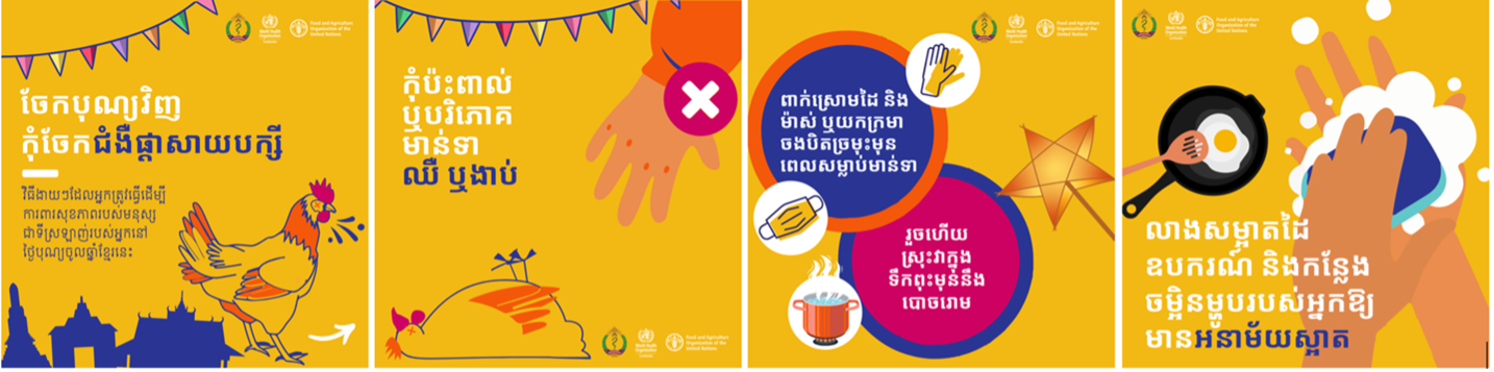
Caption: Example of social media assets of the pilot campaign for avian influenza?. The messages were simplified and made culturally relevant while the visuals matched the festive Khmer New Year atmosphere.
Credit: WHO
Institutionalizing an evidence-based approach
These efforts have institutionalized evidence-based approaches to RCCE across the Western Pacific Region. Countries are now integrating strategies to manage misinformation within their pandemic plans and influenza-related Standard Operating Procedures (SOPs). For example, in Cambodia representatives from the Ministry of Health, WHO, and partner organizations came together to review new SOPs for managing health-related misinformation and disinformation. Dr Srey Teng, Deputy-Director of Cambodia’s CDC shared: “An infodemic can be managed when we listen to the public and communities, act on evidence and speak with one voice. Behind every concern, every question is a community looking for answers. We need to fill those information gaps early before misinformation takes hold or respond quickly, consistently and with trust. With WHO’s technical guidance, this SOP also prepares Cambodia’s health workforce to respond to mis- and disinformation and prevent it from spreading.”
PIP funded WHO technical support has enabled countries across the Region to embed evidence-based risk communication and community engagement into their preparedness systems. These strengthened capacities in social listening and infodemic management are now institutionalized in pandemic plans and SOPs. For example, in Tonga, WHO technical support on infodemic management resulted in the launch of an up-to-date National Multi-Hazard Risk Communication and Community Engagement Strategy.
As the information environment continues to evolve, these foundations better equip countries to manage emerging concerns early, respond with improved clarity and consistency, and maintain the trust needed to protect communities during future health emergencies.
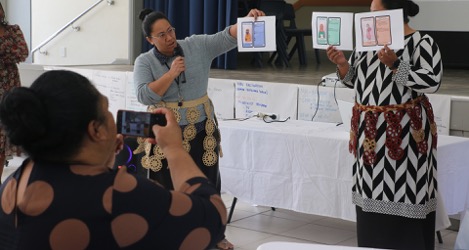
Photo caption: Ministry of health staff learn how to identify mis-information during a WHO-led workshop
Credit: WHO/J. Isaacs